

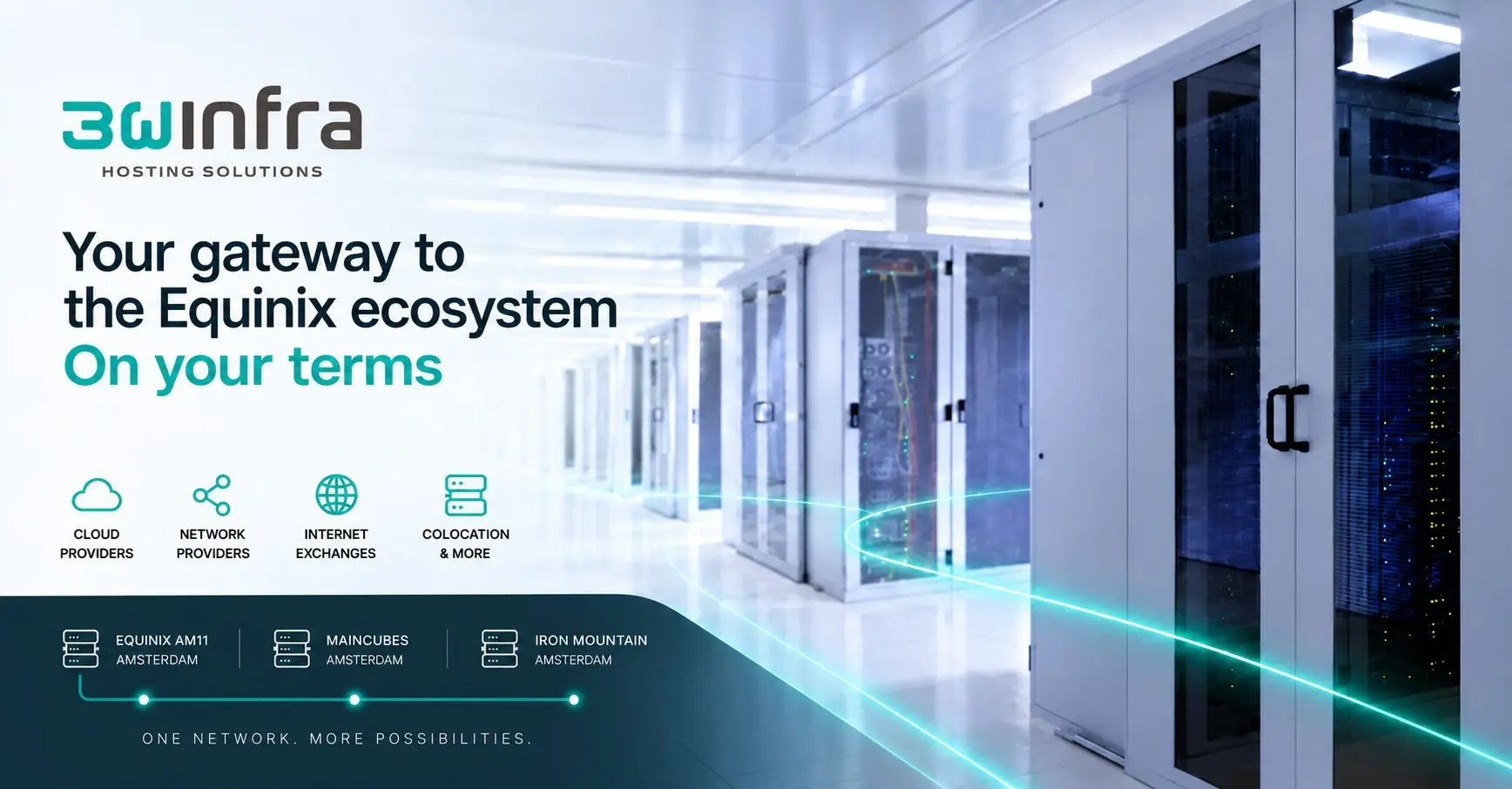
Equinix gives businesses access to far more than co-located rack space in their data centers. Its ecosystem brings together network providers, cloud platforms, internet exchanges, dedicated interconnection services, and virtual networking capabilities. Through 3W Infra's infrastructure, that ecosystem can easily become part of a broader, provider-independent architecture - without requiring a company to build its entire environment around Equinix.
For organizations running demanding IT infrastructure, that creates room to incorporate Equinix while retaining the freedom to place workloads, network connections, and services wherever they fit best. It can also reduce unnecessary dependence on a single colocation provider.
3W Infra provides access to the Equinix connectivity ecosystem through its infrastructure at Equinix AM11 in Amsterdam. Colocation customers can access this ecosystem while housing some or all of their equipment at maincubes or Iron Mountain, where full racks and power are available. All three locations are interconnected through 3W Infra's proprietary DWDM ring over redundant, maintenance-protected dark fiber, with Layer 2 and Layer 3 connectivity available between the sites.
For 3W Infra customers, the proposition goes beyond a single colocation location. Equinix can be used where it adds value, while 3W Infra integrates it with colocation, servers, storage, carriers, and network infrastructure elsewhere.
A cloud connection can terminate through Equinix while the servers consuming it remain at maincubes. A carrier available at Equinix can be extended to equipment in another facility. Production and disaster recovery environments can be separated across data centers while retaining private interconnection.
This turns the Equinix ecosystem from a destination into an infrastructure building block.
How the Equinix Ecosystem Expands Interconnection Options
Equinix becomes particularly valuable in this model at the network layer.
A company co-locating equipment in an Equinix International Business Exchange data center can establish physical cross-connects to networks and other participants available there. Equinix Fabric adds software-defined virtual connectivity to supported cloud, network, and service providers, while Equinix Internet Exchange provides another route for establishing peering relationships.
Cloud connectivity is a major part of that ecosystem. Equinix offers connectivity options for AWS Direct Connect, Microsoft Azure ExpressRoute, Google Cloud Partner Interconnect, Oracle Cloud FastConnect, and IBM Cloud Direct Link, among others.
An independent infrastructure provider like 3W Infra can approach that ecosystem differently.
3W Infra can use Equinix AM11 as an access point while extending connectivity to customer infrastructure hosted in other Amsterdam facilities. If a customer needs an uplink from a carrier unavailable at maincubes but present at Equinix, 3W Infra can obtain that connectivity through AM11 and deliver it to the customer's equipment elsewhere.
The customer can therefore select a carrier because it meets the network requirement, rather than because it happens to be present in the same building as the servers.
Extending Equinix Beyond One Data Center
Physical infrastructure and network access do not always need to occupy the same facility.
Consider an enterprise with compute and storage infrastructure at maincubes that needs connectivity to a particular international carrier through Equinix, along with private access to public cloud environments.
One option is moving the equipment. Another is extending the network.
Through 3W Infra's Amsterdam infrastructure, the customer can retain its hardware at maincubes while using Equinix AM11 as the interconnection location. 3W Infra states that its three Amsterdam sites support inter-site Layer 2 connectivity at 10, 25, 40, and 100 Gbit/s, alongside Layer 3 connectivity through its own autonomous system.
Customers can place compute and storage in full racks at maincubes or Iron Mountain while 3W Infra delivers connectivity to carriers and cloud on-ramps through Equinix AM11.
The architecture does not require every component to follow the same procurement decision.
Why an Independent Infrastructure Partner Adds Flexibility
There is a commercial difference between reselling a service and integrating infrastructure across multiple environments.
3W Infra operates colocation and network infrastructure across Equinix AM11, maincubes, and Iron Mountain in Amsterdam. maincubes functions as its principal Amsterdam-region PoP, with full-rack capacity at maincubes and Iron Mountain connected to the wider Equinix ecosystem through AM11.
The network underneath those locations is equally relevant. 3W Infra operates its own DWDM ring between the three facilities and provides Layer 2 and Layer 3 services across them. Its Layer 3 network uses its own autonomous system and is redundantly connected to multiple upstream networks and selected exchanges.
That allows infrastructure discussions to begin with the required architecture rather than a single building.
Does the workload need to run at Equinix, or does only the connectivity need to terminate there? Should production and backup sit in different facilities? Does a particular carrier need to be extended from Equinix AM11 to another rack? Should Layer 2 transport connect the environments, or would Layer 3 provide cleaner failure domains?
Those questions become easier to address when the starting point is the infrastructure requirement rather than the amount of capacity to procure from one provider.
Accessing Cloud Connectivity Without Moving Infrastructure
Private cloud connectivity illustrates the model particularly well.
An enterprise may want controlled routing or predictable connectivity between physical infrastructure and public cloud platforms without moving all of its servers next to the cloud on-ramp.
A company could keep databases, virtualization hosts, or storage systems outside Equinix while reaching Azure or AWS through the Equinix ecosystem. The Amsterdam metro network can bridge those environments, leaving physical infrastructure in one facility while the cloud-facing connection terminates through Equinix AM11.
Equinix Fabric adds further flexibility by allowing supported services to be reached through virtual connections. Fabric Cloud Router can provide Layer 3 routing between supported virtual connections, while Network Edge can introduce virtual routers and firewalls.
Those services also create dependencies.
If routing, security, and cloud connectivity become deeply embedded in one provider's virtual service layer, migrating later can become more complicated. APIs, configuration models, and operating procedures become part of the architecture.
Provider independence does not require avoiding those services. It requires deciding where the benefits justify the dependency.
How Multi-Provider Colocation Creates a Modular Architecture
A multi-provider model changes how enterprises can think about colocation. Instead of selecting one data center and forcing every requirement into it, different facilities can serve different roles.
An enterprise might run production compute in one data center and backup infrastructure in another. A SaaS provider could distribute application capacity across two facilities while using Equinix for specific carrier, peering, or cloud relationships. A hosting provider could operate server capacity across several sites while using AM11 as an interconnection point.
3W Infra supports dual- and triple-data-center configurations and Layer 2 connectivity between customer racks.
Inter-site infrastructure does introduce cost and operational complexity. Replication consumes bandwidth. Layer 2 extensions can enlarge Ethernet failure domains if poorly designed. Layer 3 architectures require routing policy and BGP expertise. Additional locations also mean more circuits, ports, cross-connects, and equipment to operate.
What it adds is another variable architects can control: location.
Compute can sit where compute makes sense. Interconnection can sit where interconnection makes sense. Backup can be separated from production. Carrier choice does not necessarily need to follow server location.
Why Provider-Independent Colocation Improves Operational Flexibility
The value of working with an independent colocation and network provider is not simply having another company on the invoice.
It is having one infrastructure party working across provider boundaries.
3W Infra says its engineers can design customer networks, operate them continuously, or hand operational control back to the customer after deployment. Its networking team supports routing, monitoring, and network maintenance, while Remote Hands services cover rack installation, cabling, optics work, and other physical tasks.
Its wider infrastructure offering also includes hardware consulting, servers, storage, and lifecycle services, with vendor relationships including Juniper, Dell, and Supermicro.
This can matter when an operational problem spans several infrastructure layers. A failed application path might cross a customer server, a 3W Infra switch, an inter-data-center optical link, an Equinix connection, and a cloud platform.
Having one infrastructure provider involved across several of those layers can simplify investigation, even though third-party dependencies remain.
Reducing Equinix Lock-In Without Losing Ecosystem Access
Vendor independence does not mean avoiding large infrastructure platforms. Equinix may be exactly where an enterprise wants certain services because of the networks, cloud connections, and interconnection options available there.
Lock-in becomes more relevant when using one useful service makes unrelated parts of the architecture difficult to move.
If servers, network equipment, cloud connections, and carrier relationships all depend on one campus, relocating one part of the platform can become disproportionately difficult. The same applies to virtual services, APIs, network configurations, and long-lived contract structures.
A multi-provider architecture can reduce some of that concentration, but it introduces cost of its own. More inter-data-center links need to be operated. Cross-connects and ports cost money. Multiple providers create more contractual and operational interfaces.
The goal should therefore not be maximum fragmentation.
A more useful objective is controlled optionality: enough separation to move a workload, add another facility, change a carrier, or adopt another connectivity model without rebuilding the whole platform.
Designing Real Network Diversity Across Colocation Facilities
Using multiple data center brands does not automatically create resilience.
Two connections can still share the same metro fiber route. Two carriers may depend on common underlying infrastructure. Two cloud connections can terminate through the same on-ramp. Several facilities can still rely on a single customer router or network device.
3W Infra's Amsterdam design addresses part of that problem through its DWDM ring connecting Equinix, maincubes, and Iron Mountain over redundant, maintenance-protected dark fiber. Customers should still examine the complete service path for their specific deployment.
That includes physical fiber routes, network termination equipment, carrier diversity, cross-connects, BGP configuration, and failover capacity.
Provider diversity and path diversity solve different problems. Architecture should follow the failure domains that matter.
Using Equinix Without Making It Your Core Data Center Platform
The Equinix ecosystem is valuable because it combines physical infrastructure with carriers, peering, private cloud connectivity, and virtual networking services.
3W Infra adds another possibility: those capabilities do not have to stop at the Equinix facility boundary.
A carrier reached through Equinix can serve infrastructure hosted elsewhere. A private cloud connection can support servers in another Amsterdam data center. Full racks at maincubes or Iron Mountain can combine with interconnection through Equinix AM11. Layer 2 can connect environments requiring Ethernet adjacency, while Layer 3 and BGP can create stronger routing boundaries.
For the enterprise, the procurement question changes.
Instead of choosing Equinix or another provider, it becomes possible to decide which parts of Equinix are useful, where the physical infrastructure should run, which connectivity should cross between facilities, and which provider dependencies are acceptable.
Equinix can be the cloud interconnection point without being the compute location. It can be the carrier access point without being the production data center. It can host part of the infrastructure without defining all of it.
That is where the independent infrastructure model becomes useful: consuming the ecosystem without automatically adopting its facility boundaries as the boundaries of the architecture.
Strategic Insights FAQ
When does provider independence become commercially valuable rather than architecturally desirable?
It becomes valuable when changing carriers, facilities, or cloud connectivity can be achieved without costly workload migration, contract disruption, or prolonged operational risk.
How should enterprises assess whether Equinix access justifies its premium positioning?
Evaluate which networks, cloud on-ramps, peering relationships, and interconnection services genuinely improve performance, flexibility, or resilience relative to alternative access models.
Where can multi-provider colocation reduce strategic infrastructure risk?
It reduces concentration risk when workloads, connectivity, and recovery capacity can be separated across providers without creating excessive inter-site complexity or duplicated operational overhead.
What should CIOs examine before extending connectivity between separate facilities?
They should assess latency, capacity headroom, physical route diversity, failover behavior, security boundaries, and whether applications genuinely require Layer 2 adjacency across locations.
When does provider optionality justify additional network and operational complexity?
Optionality earns its cost when future supplier changes, expansion, regulatory demands, or resilience requirements would otherwise force disruptive migrations or constrain commercial negotiating leverage.
How can enterprises use Equinix without making it the architectural center of gravity?
Treat Equinix as a selective interconnection layer for carriers, clouds, or peering while keeping compute, storage, and recovery infrastructure deployable across independent facilities.
Equinix access without Equinix lock-in - is that possible?
Yes. 3W Infra connects Equinix AM11 with other Amsterdam facilities while providing access to the wider Equinix ecosystem worldwide, combining interconnection, independent colocation, networking, and operational support.
Discuss Your Equinix Colocation and Interconnection Strategy with 3W Infra
Want to discuss how Equinix access, multi-site colocation, carrier choice, and private connectivity can work together without unnecessary provider dependency? Talk to the infrastructure experts at 3W Infra. Contact us at [email protected].